

Google has launched the August 2026 spam update, giving website owners and SEO professionals another reason to review how they create content, build links, and grow organic search visibility.
According to Google’s Search Status Dashboard, the update began on August 18, 2026, and applies globally across all languages. Google says the rollout may take a few days to complete.
This is a spam update, not a core update. That distinction matters. A spam update is focused on detecting and reducing the visibility of pages or sites that violate Google’s spam policies or use tactics designed to manipulate Search.
For website owners, the best response is not panic or a sudden SEO overhaul. The better approach is to understand what Google considers spam, review recent changes in Search Console, and make sure your site provides genuine value to visitors.
What Is the August 2026 Spam Update?
The August 2026 spam update is a Google Search ranking update designed to improve the detection and handling of spammy practices.
Google officially released the update on August 18 and stated that it is global and applies to all languages. The company also indicated that the rollout could take several days.
Google’s spam policies cover practices that attempt to deceive users or manipulate Search systems to gain better visibility. Sites that violate these policies can experience lower rankings or may be excluded from search results.
Because this is a spam update, not every website experiencing ranking movement should assume it has been penalized. Search rankings can change for many reasons, including competitors, indexing changes, search demand, technical issues, and normal SERP fluctuations.
Why Does This Update Matter?
Spam updates matter because they can affect the visibility of websites that rely heavily on manipulative SEO techniques.
For example, a website might publish hundreds of low-value pages simply to target long-tail keywords. Another site might build large numbers of unnatural backlinks or use misleading content to attract search traffic.
These tactics can create short-term gains, but they don’t necessarily provide a useful experience for searchers.
Google’s Search Essentials recommends creating helpful, reliable, people-first content and avoiding practices covered by its spam policies.
That makes this update particularly relevant for publishers, affiliate websites, bloggers, agencies, and businesses that have been scaling SEO content or link-building campaigns.
Is AI-Generated Content Automatically Spam?
No.
This is one of the most important points to understand.
Using AI to help research, outline, edit, or draft content does not automatically mean a page violates Google’s spam policies. The bigger issue is whether the final content provides useful information or exists mainly to manipulate search rankings.
For example, an AI-assisted article can be valuable when a writer adds:
- Original research
- First-hand experience
- Expert commentary
- Useful examples
- Accurate sources
- Original data
- Practical recommendations
- Meaningful analysis
On the other hand, publishing large amounts of repetitive content with little originality or user value can create quality and spam concerns.
Google’s Search Essentials specifically recommends people-first content rather than content created primarily to manipulate rankings.
What SEO Practices Should You Review?
1. Scaled Content
Look at how many pages you are publishing and why they exist.
If your website has hundreds or thousands of pages that say almost the same thing with minor keyword changes, those pages deserve a closer review.
Ask a simple question:
Would this page still be useful if Google did not exist?
If the answer is no, the page may need substantial improvement.
2. Unnatural Link Building
Backlinks can be useful, but manipulating links to influence rankings can violate Google’s spam policies.
Review your recent link-building campaigns for patterns such as:
- Large numbers of low-quality links
- Irrelevant websites
- Excessive exact-match anchors
- Paid links intended to pass ranking signals
- Automated link placements
- Networks created mainly for SEO
Not every directory or guest post is automatically harmful. Relevance, editorial quality, transparency, and the overall link profile matter.
3. Keyword Stuffing
Repeating the same keyword excessively doesn’t make an article more relevant.
Instead of writing the keyword into every heading and paragraph, cover the topic naturally and use related terminology where appropriate.
For example, an article about the August 2026 spam update can naturally discuss:
- Google Search ranking
- spam policies
- SEO practices
- search visibility
- content quality
- link manipulation
- organic traffic
The reader should never feel that the article was written for a keyword counter.
4. Misleading Pages
Pages should deliver what their titles and search snippets promise.
If a title promises a detailed guide but the page contains a short, generic answer surrounded by advertisements and unrelated content, users are unlikely to find it useful.
Clear titles and accurate descriptions help create a better search experience.
How to Check Whether Your Website Was Affected
Don’t judge the impact from one day’s traffic.
The August 2026 update is still rolling out, so short-term fluctuations may not tell the complete story. Google says the rollout may take a few days.
Instead, use Google Search Console and compare:
Before the update:
- Clicks
- Impressions
- Average position
- Top-performing pages
- Top queries
During and after the rollout:
- Traffic changes
- Ranking changes
- Pages losing impressions
- Queries losing visibility
- New indexing problems
Pay particular attention to pages that experienced a large and sustained decline rather than reacting to small daily movements.
Google itself recommends using its Search Status Dashboard to track notable Search updates.
What Should You Do If Rankings Drop?
First, don’t immediately delete pages or disavow large numbers of backlinks.
A ranking drop after a spam update can have different causes. Google has explained that after a spam update, changes may occur because its systems identified spam or because spammy links that previously helped a site were discounted.
Start with an audit.
Step 1: Identify affected pages
Find the URLs that lost the most impressions or clicks.
Step 2: Review content quality
Ask whether each page offers information that is genuinely useful, accurate, and sufficiently original.
Step 3: Review your link profile
Look for obvious patterns of unnatural or manipulative link acquisition.
Step 4: Check technical SEO
Make sure important pages are indexed correctly and aren’t affected by accidental noindex tags, canonical problems, redirects, or crawling issues.
Step 5: Improve the actual content
Don’t simply add more words.
Improve weak pages with better evidence, clearer explanations, original examples, useful visuals, expert insight, and information that competitors don’t provide.
Common Mistakes to Avoid During the Update
One of the biggest mistakes is making major changes before you understand what happened.
Avoid:
- Deleting large numbers of pages immediately
- Changing every URL at once
- Adding keywords just because rankings dropped
- Buying backlinks to recover traffic
- Publishing hundreds of new AI-generated pages
- Changing titles across the entire website without evidence
- Assuming every traffic decline is a Google penalty
Give the update time to roll out and analyze your data carefully.
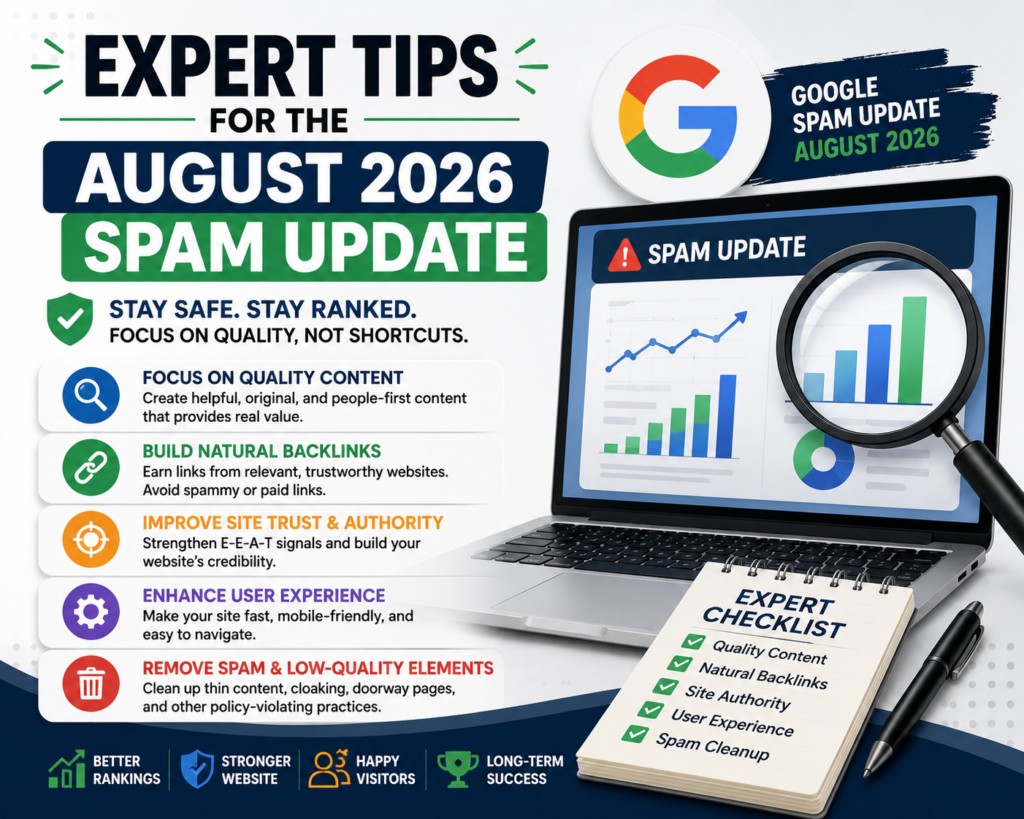
Expert Tips for the August 2026 Spam Update
Focus on usefulness, not volume
Publishing 20 excellent pages is generally more valuable than publishing 200 pages that provide little new information.
Add something competitors don’t have
Original examples, data, expert commentary, screenshots, comparisons, or first-hand observations can make a page substantially more useful.
Keep backlinks relevant
A smaller number of relevant, legitimate links can be more useful than a large collection of unrelated placements.
Review old content
Don’t focus only on new articles. Older pages can also contain thin, outdated, duplicated, or low-value information.
Don’t confuse AI assistance with spam
AI can be part of a content workflow. The important question is whether the finished page satisfies the user and follows Google’s policies.
August 2026 Spam Update vs. Core Update
These two update types should not be treated as identical.
A spam update focuses on spam-related systems and practices, while a core update is a broader change to Google’s ranking systems.
Google’s ranking history lists the May 2026 core update separately from the August 2026 spam update.
This distinction is useful when diagnosing traffic changes. If your website loses visibility during a spam update, review spam-related practices first instead of assuming that Google’s overall assessment of your content changed because of a core update.
Frequently Asked Questions
What is the August 2026 spam update?
The August 2026 spam update is a Google Search ranking update launched on August 18, 2026. Google says it applies globally and to all languages.
Is the August 2026 spam update a core update?
No. It is a spam update, separate from Google’s core updates. Google’s ranking history lists the August spam update separately from the May 2026 core update.
Does Google penalize all AI-generated content?
No. AI assistance alone does not automatically make content spam. The important issue is whether content violates Google’s policies or provides little value while being produced primarily to manipulate Search.
How long will the August 2026 spam update take?
Google says the rollout may take a few days. Website owners should therefore avoid making conclusions based on the first day or two of ranking changes.
What should I do if my traffic drops?
Use Google Search Console to identify affected pages and queries, then review content quality, backlinks, technical SEO, and possible spam-related practices. Avoid making large changes without first identifying the likely cause.
Can backlinks be affected by a spam update?
They can be. Google has explained that after a spam update, spammy links that previously contributed to rankings may be discounted.
Should I stop using AI for SEO content?
Not necessarily. Instead, use AI as a supporting tool and make sure the final content contains genuine value, accurate information, original insight, and useful information for readers.
Where can I monitor Google updates?
The most reliable place is Google’s official Search Status Dashboard, where Google publishes notable Search ranking updates and their rollout status.
Final Thoughts
The August 2026 spam update is a reminder that sustainable SEO is about more than publishing content and collecting backlinks.
Google launched the update globally on August 18 and said the rollout may take several days.
For publishers and SEO professionals, the practical response is straightforward: review your content, evaluate your link-building methods, remove manipulative practices, and make every important page genuinely useful.
Don’t assume that using AI is the problem. Don’t assume that every ranking decline is a penalty either.
Instead, look at the evidence in Search Console and improve the parts of your website that genuinely need improvement. That approach is more useful during an algorithm update—and more sustainable after the update is finished.
“Create value, not spam. Google notices the difference.”