

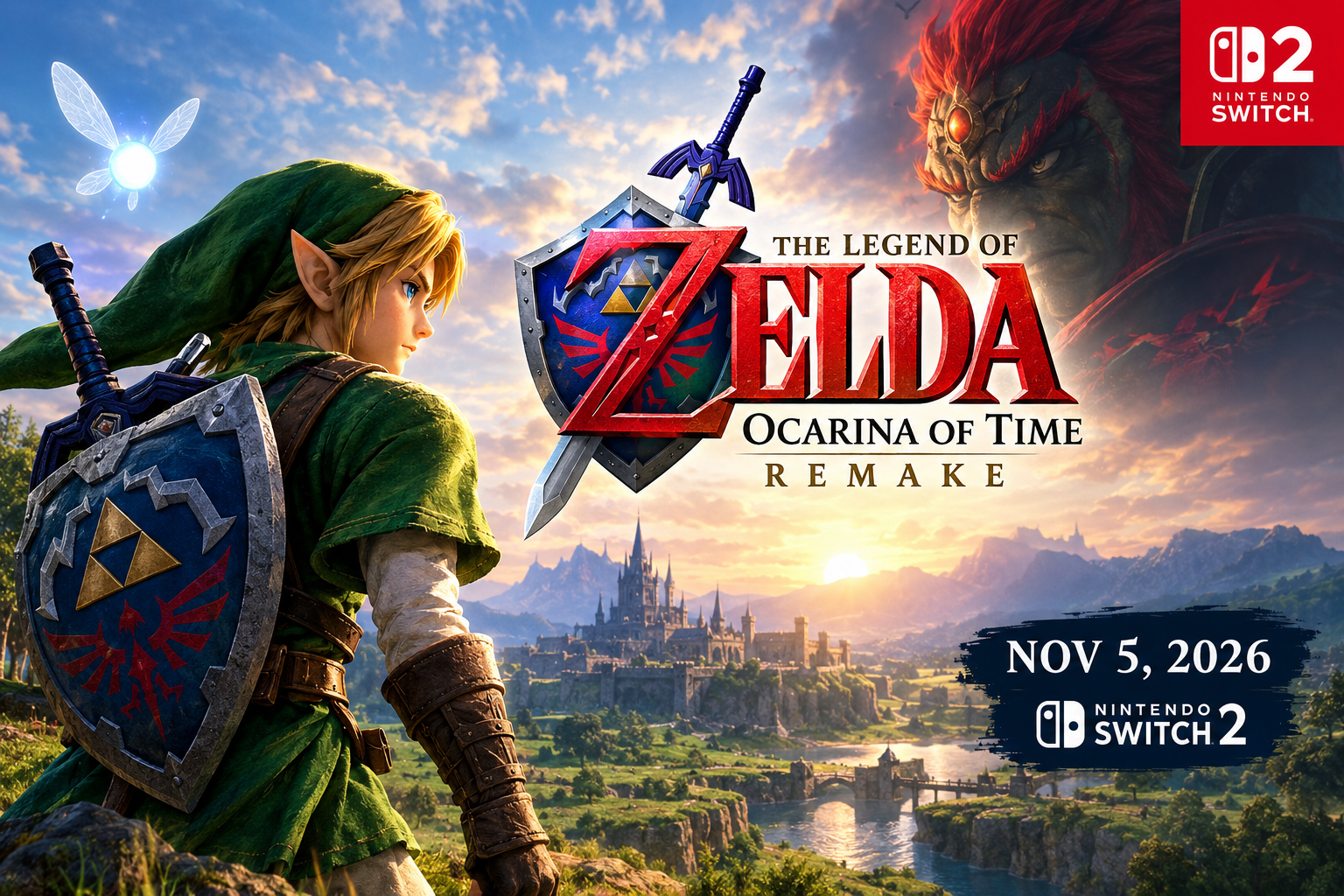
The Ocarina of Time remake is officially happening, and Nintendo has now revealed far more than the original announcement suggested. The classic Nintendo 64 adventure is being rebuilt for Nintendo Switch 2, with upgraded visuals, modern controls, expanded dialogue, voiced cutscenes, and other changes designed to make the 1998 classic feel more natural on modern hardware.
For longtime Zelda fans, this is more than another visual upgrade. Ocarina of Time helped establish many of the conventions that later 3D adventure games adopted, so Nintendo faces a difficult challenge: improve the experience without losing what made the original memorable.
Here is what we know so far, what has changed, and what players should expect from the remake.
When Is the Ocarina of Time Remake Coming Out?
Nintendo has confirmed that The Legend of Zelda: Ocarina of Time will release on November 5, 2026, exclusively for Nintendo Switch 2. Nintendo’s official store listing also confirms the November 5 release date and identifies Switch 2 as the platform.
That makes the project a full remake rather than a simple port of the Nintendo 64 version.
Nintendo initially announced the game in June 2026, describing it as the return of the critically acclaimed Nintendo 64 classic for a new generation. The September 2026 Zelda 40th Anniversary presentation then provided the first substantial look at its gameplay and features.
What Is the Ocarina of Time Remake?
The original The Legend of Zelda: Ocarina of Time launched on Nintendo 64 in 1998. It follows Link as he grows from a young Kokiri into the Hero of Time and battles Ganondorf’s attempt to obtain the Triforce.
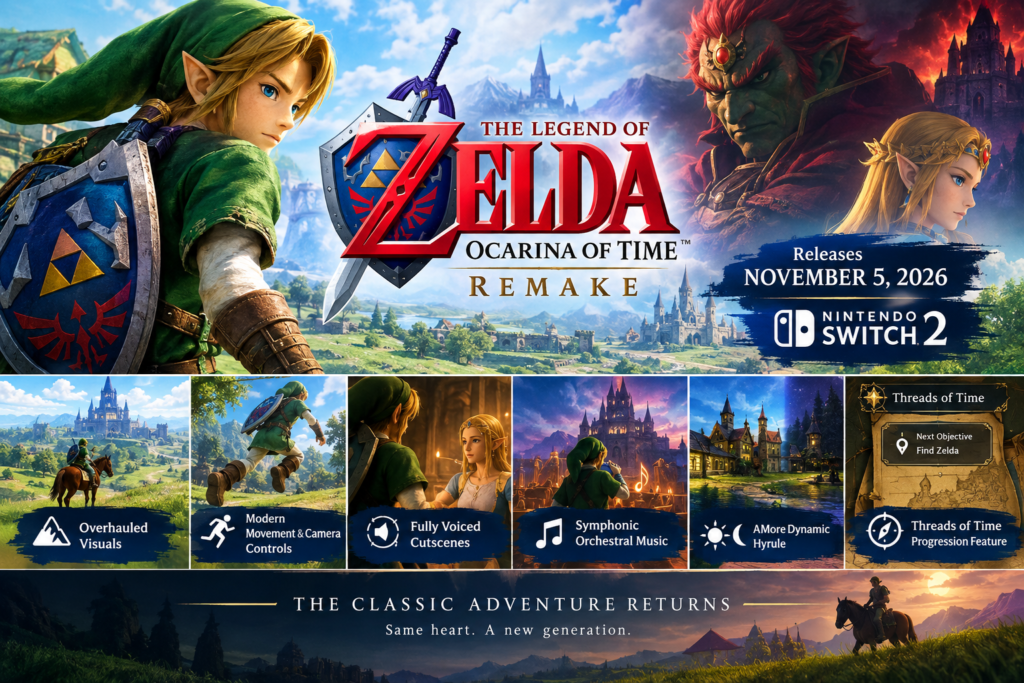
The 2026 remake keeps that core adventure but rebuilds its presentation and gameplay for modern hardware. Nintendo says the game features completely overhauled visuals, expanded dialogue, voiced cutscenes, symphonic orchestral music, improved camera controls, and new movement options.
This distinction matters. Players should not approach the project as simply Ocarina of Time 3D with sharper graphics. Nintendo is changing several parts of the presentation and control system while retaining the familiar story and adventure.
Key Features Confirmed So Far
Completely Overhauled Visuals
One of the most obvious differences is the visual presentation.
Nintendo has rebuilt the game’s environments and materials with modern graphics. Textures have been upgraded, locations have been remodeled, and the overall presentation is designed around Switch 2 hardware.
For a game originally designed around Nintendo 64 technology, this should make areas such as Kokiri Forest, Hyrule Field and the major dungeons considerably more detailed.
Modern Movement and Camera Controls
The remake also changes how Link moves.
Nintendo has confirmed newly added button commands that allow Link to jump and run more freely. Camera control has also been updated through the right stick.
This could be one of the biggest practical improvements for modern players. The original control scheme was designed around the Nintendo 64 controller, while contemporary Zelda games have established a more flexible approach to movement and camera control.
Fully Voiced Cutscenes
Another significant change is the addition of voice acting.
Characters appearing in the adventure will have expanded dialogue, while cutscenes have been reworked with full voice performances.
That could give familiar scenes a very different atmosphere. At the same time, longtime fans may have strong opinions about how iconic characters sound compared with the voices they have imagined for decades.
Symphonic Orchestral Music
The soundtrack is also receiving an overhaul.
Nintendo says the remake includes symphonic orchestral music, alongside refreshed sound.
Music has always been a major part of Ocarina of Time, particularly because songs and musical instruments are integrated directly into the gameplay. A larger orchestral presentation could make locations and story sequences feel more cinematic without changing their underlying role.
A More Dynamic Hyrule
Nintendo is also making Hyrule feel more active.
The day-and-night cycle now continues even when Link is in towns, while remodeled locations include additional environmental details and allow more flexible camera movement.
These may seem like relatively small adjustments, but they can change how players experience familiar locations. A world that continues to evolve while Link moves through it can feel less like a collection of fixed game areas.
What Is Threads of Time?
One of the more interesting additions is a feature called Threads of Time.
Nintendo describes it as a way to check the progress Link has made through the story and see the next objective at any point during the adventure.
For returning players, this may simply be a convenient reference tool. For newcomers, it could reduce the frustration that sometimes comes from older adventure games, where the next objective was not always clearly presented.
The important question will be whether it remains helpful without turning exploration into a checklist. Ocarina of Time works partly because players are encouraged to explore, experiment and remember clues.
How Different Will It Be From the Original?
The remake appears to preserve the basic identity of the original while modernizing several systems around it.
That is a sensible approach. Completely rewriting the game could remove some of the qualities that made the 1998 version special. On the other hand, simply increasing the resolution would leave many older design limitations untouched.
Nintendo’s changes sit somewhere between those extremes.
The story remains centered on Link, Zelda, Ganondorf, the Triforce and the Hero of Time. The difference is that the adventure is being presented through a much more modern technical framework.
Is It a Remaster or a Full Remake?
It is best described as a full remake.
Nintendo says the game has been built for Switch 2 with overhauled visuals, remodeled locations, refreshed audio, expanded dialogue, new movement controls and other gameplay improvements.
That goes considerably further than a straightforward remaster, where the original game’s assets and systems would generally remain much closer to their original form.
Why This Remake Matters
Ocarina of Time occupies an unusual place in gaming history.
The original 1998 release helped define how large-scale 3D adventure games could handle exploration, combat, puzzles, targeting and cinematic storytelling. Its influence can still be seen throughout the genre.
Remaking it in 2026 therefore presents two competing goals.
Nintendo needs to make the game comfortable for players who grew up with modern Zelda titles, while also preserving the structure that longtime fans recognize.
That balance will probably be one of the most discussed aspects of the remake after launch.
What New Players Should Know
If you have never played Ocarina of Time, the remake could be a particularly accessible way to experience the story.
The modern camera, movement options, clearer progression system and updated presentation remove several barriers associated with playing a game originally designed for 1998 hardware.
Still, players should not expect the design philosophy of Breath of the Wild or Tears of the Kingdom.
This remains a more structured Zelda adventure. Dungeons, story progression, item-based puzzles and carefully designed areas remain central to the experience.
That difference is part of its appeal.
What Returning Fans Should Watch For
Veteran players will probably pay less attention to the basic story and more attention to the changes.
The biggest areas to watch are:
- How the redesigned environments compare with the original locations
- Whether the new camera changes combat
- How freely Link can move
- How the voiced dialogue affects classic scenes
- Whether the new progression system changes exploration
- How the orchestral soundtrack handles familiar themes
- Whether additional environmental details change previously familiar areas
Nintendo has clearly invested in making the remake feel modern, but the success of that approach will depend on how naturally those changes fit into the original adventure.
Common Misconceptions
Is the remake coming to the original Nintendo Switch?
Nintendo has announced the remake for Nintendo Switch 2, and its official product listing identifies Switch 2 as the supported console.
Is this the same as Ocarina of Time 3D?
No. Ocarina of Time 3D was the Nintendo 3DS version released in 2011. The 2026 project is a separate remake built for Nintendo Switch 2.
Is the story being completely rewritten?
Nintendo’s announced material indicates that the remake retains the original adventure while expanding dialogue, cutscenes and presentation. There has been no indication that the fundamental story has been replaced.
Does Link have new movement abilities?
Yes. Nintendo has confirmed new button commands that allow Link to jump and run more freely, alongside improved camera control.
Expert Take: What Could Make the Remake Successful?
The strongest version of this remake would not try to turn Ocarina of Time into a completely different Zelda game.
Its biggest opportunity is to remove technical friction while protecting the game’s sense of discovery.
Better camera controls make sense. Modern movement makes sense. Improved visuals and sound are natural upgrades. A helpful progression feature can also benefit new players.
The harder task is knowing where to stop.
If every old limitation is removed, the remake could lose some of the character that made the original distinctive. But if Nintendo changes too little, players may wonder why the game needed a full remake in the first place.
That tension will define the final experience.
Final Thoughts
The Ocarina of Time remake is shaping up to be one of Nintendo’s most significant Zelda releases of 2026. It brings the 1998 classic to Switch 2 with modern visuals, redesigned locations, updated movement, improved camera controls, voiced cutscenes, expanded dialogue and orchestral music.
With a confirmed November 5, 2026 release date, the wait is now much more concrete for Zelda fans.
The real test will not be whether Nintendo can make Ocarina of Time look better. It clearly can. The bigger question is whether these modern improvements can coexist with the atmosphere, pacing and sense of discovery that made the original adventure endure for generations.
FAQ
1. When does the Ocarina of Time remake release?
The remake launches on November 5, 2026, for Nintendo Switch 2.
2. Is Ocarina of Time remake exclusive to Switch 2?
Yes. Nintendo’s official listings identify Nintendo Switch 2 as the platform for the remake.
3. Will the remake have better graphics?
Yes. Nintendo has completely overhauled the visuals, including textures and remodeled environments.
4. Will characters have voice acting?
Yes. Nintendo has confirmed fully voiced cutscenes and expanded character dialogue.
5. Does Link have modern controls?
Yes. The remake adds new button commands for movement, including jumping and freer running, plus improved right-stick camera control.
6. What is Threads of Time?
Threads of Time is a progression feature that lets players review their story progress and see their next objective during the adventure.
7. Is this the same game as Ocarina of Time 3D?
No. The 2026 version is a new Switch 2 remake, separate from the 2011 Nintendo 3DS release.
8. Is the original story still included?
Yes. Nintendo’s announced remake retains the classic Link, Zelda and Ganondorf adventure while modernizing its presentation and gameplay.