

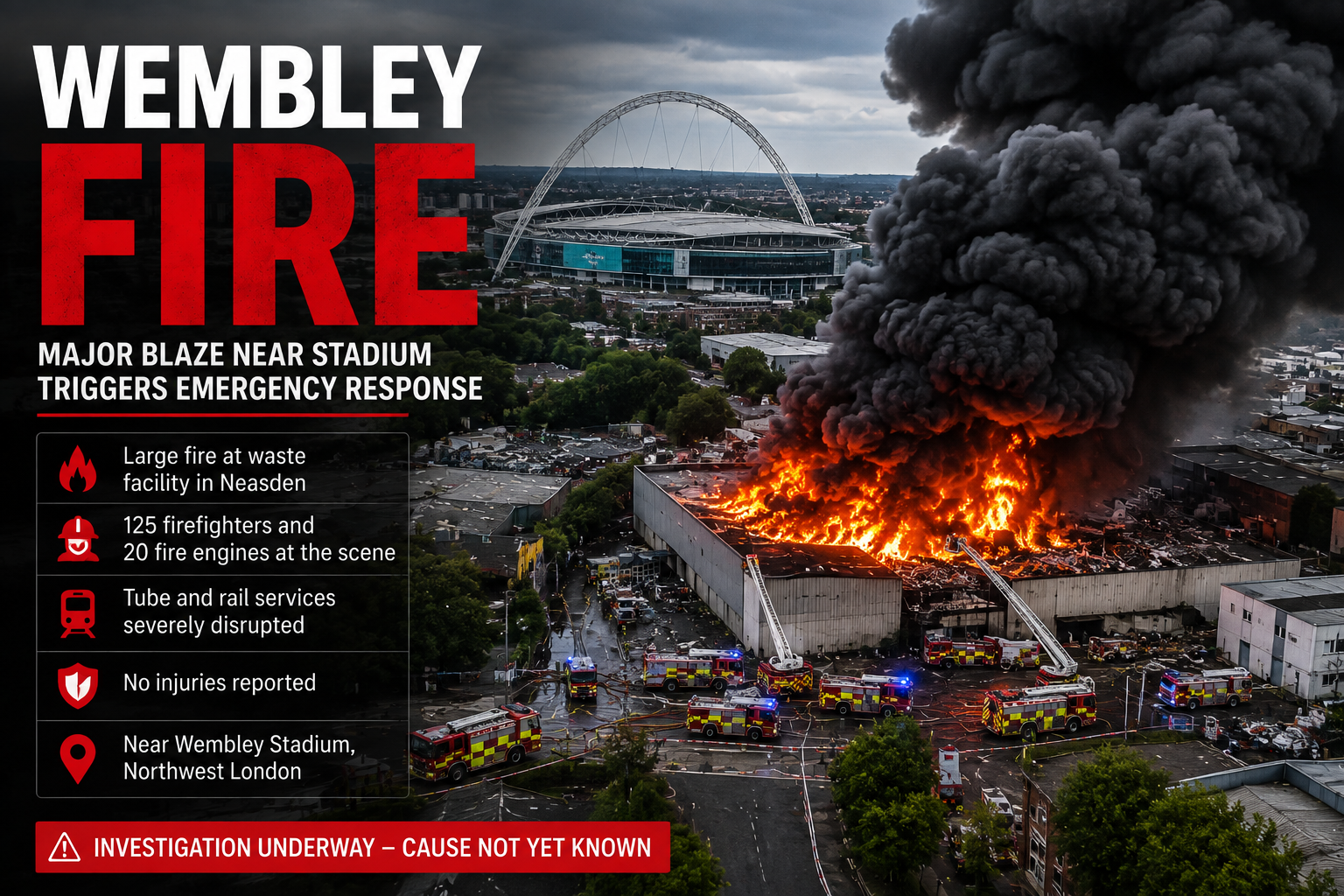
A major Wembley fire broke out on Friday, August 28, 2026, at an industrial site on Hannah Close in Neasden, northwest London, close to Wembley Stadium. The blaze involved a mixed-waste facility and produced large clouds of smoke that could be seen from across parts of London.
The incident triggered a large emergency response. Around 125 firefighters and 20 fire engines were sent to the scene, while specialist equipment was also brought in to help crews tackle the fire.
Although the fire was close to the famous stadium, reports indicate that the blaze was at an industrial facility rather than inside Wembley Stadium itself.
What Happened in the Wembley Fire?
The fire started at a mixed-waste facility on an industrial estate in the Hannah Close area of Neasden. The London Fire Brigade received the first reports shortly after 11:30 a.m., with more than 70 calls eventually being made about the incident.
Large amounts of smoke rose from the site, prompting the London Fire Brigade to advise people living nearby to close their windows and doors and remain indoors where possible.
There were reports of an explosion or loud bang, but the cause of the fire had not been established at the time of the latest official updates. It is therefore important not to treat early reports about the cause as confirmed facts.
Why Was the Fire So Serious?
The scale of the emergency response reflected the size and intensity of the blaze. The affected industrial unit was reported to be roughly 100 metres by 150 metres, requiring substantial firefighting resources.
Fire crews used specialist equipment, including high-volume pumping equipment, hose-laying equipment and aerial ladders. These resources helped firefighters approach the large industrial site while managing the significant amount of smoke being produced.
The incident also created concerns beyond the immediate fire ground because of its proximity to busy transport routes and commercial properties.
Impact on London Transport
One of the most noticeable effects of the fire was disruption to public transport.
The Metropolitan line was suspended, while the Jubilee line was also affected, particularly between Willesden Green and Wembley Park. Rail services operating into and out of London Marylebone also experienced delays and cancellations.
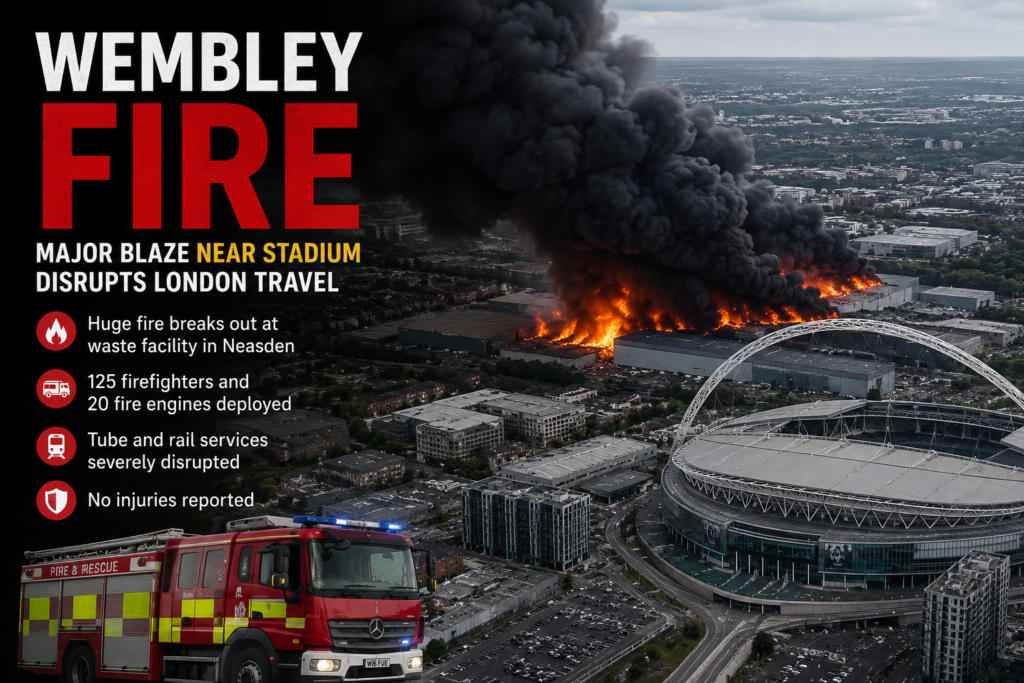
These disruptions mattered because the Wembley and northwest London area is served by several important Tube and rail connections. Smoke, emergency vehicles and the need to keep people away from the affected area all contributed to the transport problems.
Anyone travelling through the area during a major incident should check current Transport for London and National Rail information rather than relying on an earlier timetable.
Was Wembley Stadium on Fire?
No. The major fire was not reported as a fire inside Wembley Stadium.
The blaze occurred at an industrial waste facility in Neasden, near the stadium. Because Wembley Stadium is such a well-known landmark, descriptions such as “fire near Wembley Stadium” quickly attracted attention.
This distinction is important when sharing information online. Calling it a “Wembley Stadium fire” could incorrectly suggest that the stadium itself was burning.
Were People Injured?
According to the latest statement from the North London Waste Authority, all LondonEnergy employees were safe and there were no reported injuries connected with the incident.
A nearby Amazon warehouse was also evacuated as a precaution, according to reports. The evacuation was a safety measure and does not mean the warehouse itself was the source of the fire.
What Caused the Wembley Fire?
The cause remained under investigation in the latest available reports.
That means claims about a specific cause should be treated carefully until investigators provide confirmed findings. Fires at waste and recycling facilities can have complicated origins because different materials may be stored together, but that does not establish what caused this particular incident.
Recent discussions around waste-facility fires have also highlighted the risks associated with incorrectly discarded lithium batteries. However, there is currently no confirmed evidence that a lithium battery caused this particular Wembley-area fire.
What Happens Next?
London Fire Brigade remained at the site after the initial response, while the facility itself remained inaccessible to its operator.
The North London Waste Authority said contingency arrangements were being used to redirect waste that would normally be handled at the Wembley transfer station through other parts of the LondonEnergy network.
Further investigation will be needed before the full extent of damage and the cause of the fire can be established.
What Should People Near Wembley Do?
If there is heavy smoke in your area during a nearby fire, practical steps include:
- Keep windows and external doors closed.
- Stay indoors if emergency services advise it.
- Avoid travelling toward the incident.
- Keep away from roads needed by emergency vehicles.
- Check official transport updates before starting a journey.
- Follow instructions from the London Fire Brigade and local authorities.
- Avoid sharing unverified claims about the cause of the fire.
Smoke can travel beyond the immediate fire location, so following official safety advice is more useful than trying to judge the situation from social media videos.
Common Mistakes When Reporting a Fire
Large incidents often generate confusion online. A few common mistakes are worth avoiding.
Mistake 1: Saying Wembley Stadium caught fire.
The reported blaze was at an industrial waste facility near Wembley, not inside the stadium.
Mistake 2: Assuming an explosion caused the fire.
Reports mentioned an explosion or loud bang, but the official cause remained under investigation.
Mistake 3: Sharing old information as current news.
Wembley has experienced several separate fires in 2026, including incidents at commercial and residential properties. These should not be confused with the August 28 waste-facility fire.
Mistake 4: Ignoring official safety advice.
When smoke is widespread, residents should follow emergency-service instructions instead of approaching the scene.
Wembley Fire: Key Facts at a Glance
| Detail | Information |
|---|---|
| Date | August 28, 2026 |
| Location | Hannah Close, Neasden, northwest London |
| Type of site | Mixed-waste facility |
| Fire response | Around 125 firefighters |
| Fire engines | 20 |
| Injuries | No injuries reported by the waste authority |
| Transport impact | Metropolitan and Jubilee lines affected |
| Cause | Under investigation |
| Nearby landmark | Wembley Stadium |
Frequently Asked Questions
What was the Wembley fire?
The Wembley fire was a major blaze at a mixed-waste facility on Hannah Close in Neasden, near Wembley Stadium, on August 28, 2026.
Did Wembley Stadium catch fire?
No. The reported fire occurred at an industrial waste facility near Wembley Stadium, not inside the stadium.
How many firefighters attended the Wembley fire?
Around 125 firefighters and 20 fire engines were deployed to tackle the blaze.
Were there any injuries?
The North London Waste Authority reported that all LondonEnergy employees were safe and that there were no injuries.
What caused the Wembley fire?
The cause was still under investigation in the latest available reports. No specific cause should be presented as confirmed until investigators release further information.
Did the fire affect London transport?
Yes. The Metropolitan line was suspended, parts of the Jubilee line were affected, and rail services around London Marylebone experienced disruption.
Was the nearby Amazon warehouse affected?
The warehouse was evacuated as a precaution, according to reports.
Is the Wembley waste facility operating normally?
The operator said the site remained inaccessible while London Fire Brigade continued dealing with the incident. Waste was being redirected through other parts of the network as a contingency measure.
Final Thoughts
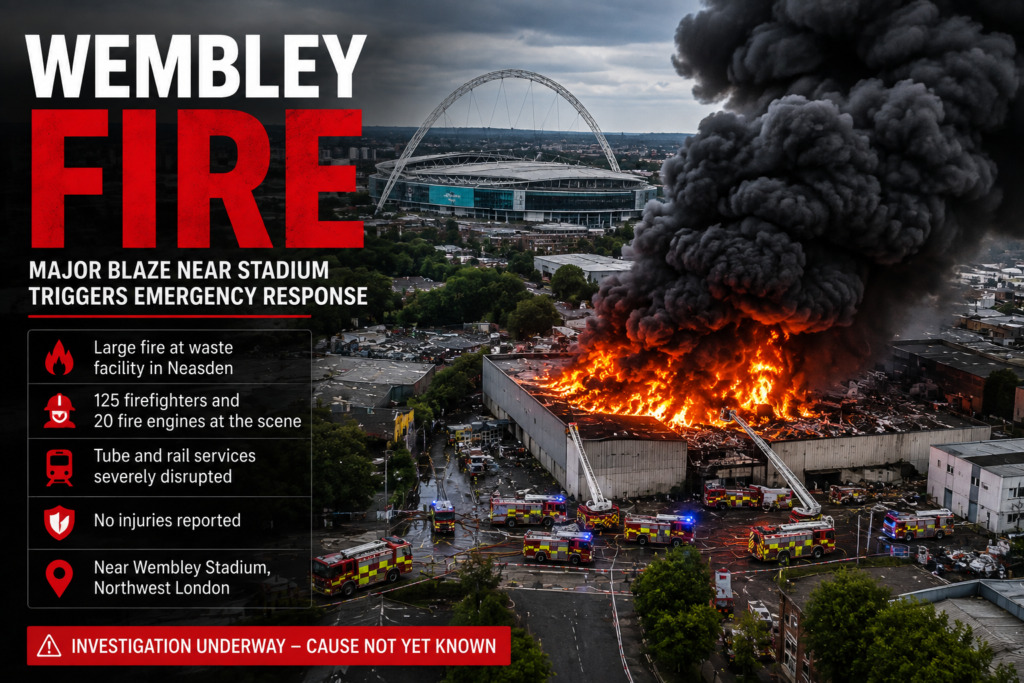
The Wembley fire was a major industrial blaze near one of London’s best-known landmarks, but it is important to distinguish the location of the fire from Wembley Stadium itself. The incident required a large emergency response, generated substantial smoke and caused significant transport disruption.
With the cause still under investigation, the safest approach is to rely on official updates rather than speculation. The latest available information indicates that no injuries were reported by the waste authority, while emergency crews continued dealing with the consequences of the fire.