
Introduction
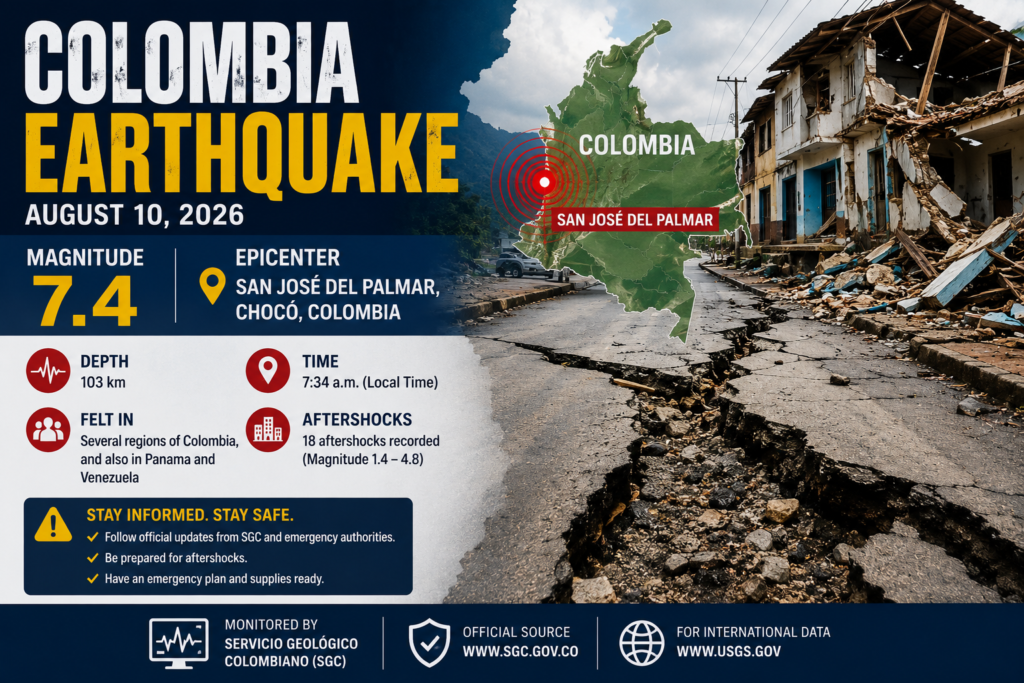
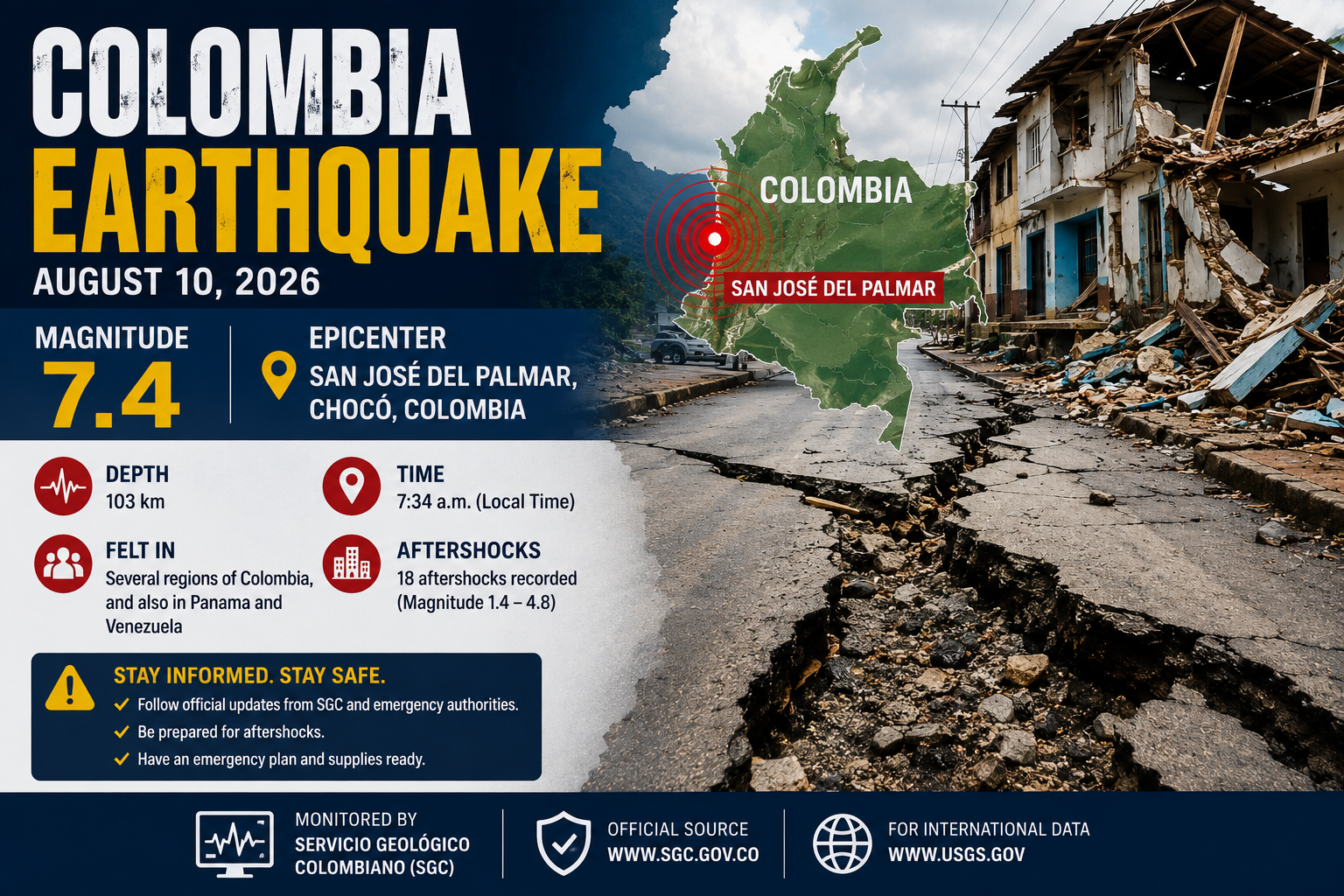
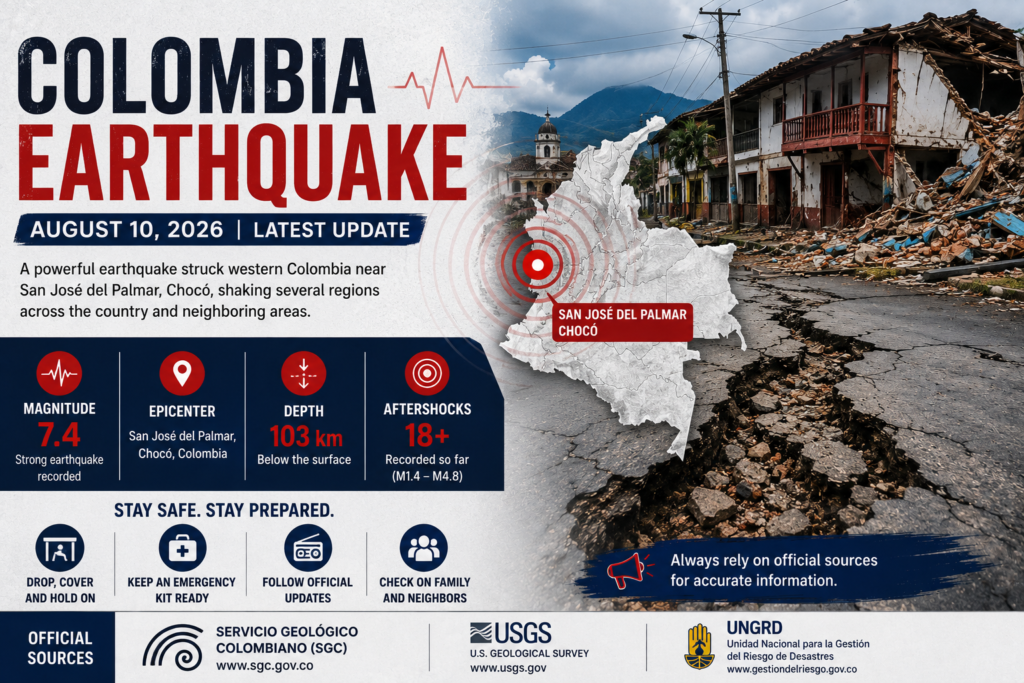
The Colombia earthquake reported on August 10, 2026, became a major seismic event for the country. According to the Servicio Geológico Colombiano (SGC), the earthquake had a magnitude of 7.4 and was centered in the municipality of San José del Palmar, Chocó, at a depth of about 103 kilometers. The USGS also recorded the event as magnitude 7.4, with its location near San José del Palmar.
This guide explains what happened, why the earthquake was felt across a wide area, what aftershocks mean, why Colombia is seismically active, and where readers should look for reliable updates.
Colombia Earthquake: What Happened?
The major earthquake occurred on August 10, 2026, at approximately 7:34 a.m. local time, according to the SGC.
Key information includes:
| Detail | Information |
|---|---|
| Magnitude | 7.4 |
| Location | San José del Palmar, Chocó |
| Depth | About 103 km |
| Date | August 10, 2026 |
| Region | Western Colombia |
| Monitoring Agency | Servicio Geológico Colombiano |
| USGS Magnitude | 7.4 |
The SGC described it as the largest-magnitude earthquake recorded in Colombia during the 21st century. More than 12,000 people had submitted reports describing how they felt the earthquake by the time of the agency’s initial update. Reports also indicated that shaking was felt in parts of Panama and Venezuela.
Where Was the Earthquake?
The epicenter was in San José del Palmar in the department of Chocó, in western Colombia.
The area is part of a seismically active region influenced by interactions between tectonic plates. The SGC explains that the Nazca Plate moves beneath the South American Plate in the Pacific region, creating conditions that can generate earthquakes.
Why Was the Colombia Earthquake Felt So Widely?
Earthquake depth and magnitude both influence how shaking is experienced.
Although this earthquake occurred at a depth of more than 100 kilometers, its large magnitude allowed significant energy to travel through the Earth’s crust.
The SGC specifically explained that a very large earthquake can still be widely felt even when its focus is not close to the surface.
This is an important distinction:
- Magnitude describes the size or energy of an earthquake.
- Depth describes how far below the surface the earthquake begins.
- Intensity describes the effects or shaking experienced at a particular location.
An earthquake can therefore have the same magnitude but produce different levels of shaking in different communities.
Colombia Earthquake Aftershocks
Aftershocks are smaller earthquakes that occur following a larger main earthquake.
The SGC reported 18 aftershocks by the time of its August 10 update, with magnitudes ranging from 1.4 to 4.8. The agency also warned that additional aftershocks could continue.
What Should You Do During Aftershocks?
If you are in an affected area:
- Stay alert after the main earthquake.
- Move away from damaged structures.
- Avoid elevators.
- Follow instructions from emergency authorities.
- Keep essential supplies nearby.
- Check official seismic updates rather than relying on social media rumors.
Aftershocks can occur for days, weeks, or sometimes longer after a significant earthquake.
Why Does Colombia Have So Many Earthquakes?
Colombia is located in a complex tectonic environment.
The country’s seismic activity is influenced by interactions involving the Nazca, South American, and Caribbean plates. The SGC describes Colombia as a seismically active country, with earthquakes occurring across much of its territory.
The SGC says Colombia experiences roughly 2,500 earthquakes per month, although most are too small or too deep for people to notice. Modern monitoring systems make many of these events easier to detect and report.
Can Scientists Predict the Next Earthquake?
No reliable scientific method currently allows researchers to predict exactly when, where, and how strong the next earthquake will be.
The SGC emphasizes that earthquakes and their aftershocks cannot currently be predicted with a scientifically proven method. Instead, monitoring networks track seismic activity and provide information to authorities and the public.
This makes earthquake preparedness especially important.
How to Stay Safe During an Earthquake
The SGC recommends taking protective action during an earthquake and preparing before one occurs.
If You Are Indoors
- Protect yourself from falling objects.
- Move away from windows and glass.
- Use a sturdy desk or another safe protective position when appropriate.
- Do not use elevators.
- Stay calm and follow established emergency procedures.
If You Are Outside
Move away from buildings, power lines, trees, and other objects that could fall.
If You Are Driving
Slow down and assess the surroundings. Roads, bridges, tunnels, and other infrastructure may present additional hazards after strong shaking.
After the Earthquake
Check yourself and people nearby for injuries. If your building has serious structural damage, leave when it is safe to do so and follow instructions from emergency authorities.
If you smell gas, avoid flames and electrical switches and move to a safer location.
How Colombia Monitors Earthquakes
The Servicio Geológico Colombiano operates Colombia’s national seismic monitoring network.
The SGC reported that its network includes more than 200 monitoring stations distributed throughout the country and operates continuously to track seismic activity.
For the most reliable information, readers should check official monitoring agencies instead of relying on unverified posts.
Official Sources to Check
- Servicio Geológico Colombiano for Colombian earthquake information.
- USGS for international earthquake data.
- Unidad Nacional para la Gestión del Riesgo de Desastres for emergency and disaster-management information.
Common Mistakes After an Earthquake
Avoid these mistakes after a major earthquake:
- Sharing unverified casualty numbers.
- Treating social media posts as official warnings.
- Returning to visibly damaged buildings.
- Ignoring aftershock warnings.
- Using elevators during an emergency.
- Assuming a quiet period means no more shaking can occur.
- Spreading predictions about the next earthquake.
Official information can change as agencies receive new data, so check the latest updates before sharing information.
Frequently Asked Questions
What was the magnitude of the Colombia earthquake?
The August 10, 2026 earthquake near San José del Palmar, Chocó, was reported as magnitude 7.4 by both the SGC and USGS.
Where did the Colombia earthquake happen?
The epicenter was near San José del Palmar in Chocó, Colombia.
How deep was the Colombia earthquake?
The SGC reported a depth of approximately 103 kilometers.
Were there aftershocks?
Yes. The SGC reported 18 aftershocks in its initial update, ranging from magnitude 1.4 to 4.8. More aftershocks were considered possible.
Why does Colombia experience earthquakes?
Colombia sits in a complex tectonic region where several plates interact, including the Nazca, South American, and Caribbean plates.
Can the next Colombia earthquake be predicted?
No. There is currently no scientifically proven method for predicting the exact time, location, and magnitude of an earthquake.
Where can I check Colombia earthquake updates?
The Servicio Geológico Colombiano provides official seismic monitoring and earthquake information for Colombia. The USGS is another reliable source for international earthquake data.
What should I do after a strong earthquake?
Check for injuries, stay away from damaged structures, watch for aftershocks, and follow instructions from official emergency authorities.
Is every earthquake in Colombia dangerous?
No. Colombia experiences many earthquakes that are too small or deep to be felt. The SGC reports that most of the country’s roughly 2,500 monthly earthquakes are not perceptible to people.
Where can I learn about Colombia’s earthquake risk?
The Servicio Geológico Colombiano provides national seismic-hazard information, including maps and tools used to understand earthquake risk and support safer planning.
Internal Linking Opportunities
For The Daily Nook, consider adding natural internal links to:
- Latest world news updates
- Natural disasters and emergency preparedness
- Earthquake safety tips
- Travel safety guide
- How to prepare an emergency kit
Authoritative External Sources
For this article, use these authoritative sources:
- Servicio Geológico Colombiano (SGC) — official Colombian seismic monitoring and earthquake information.
- U.S. Geological Survey (USGS) — independent international earthquake monitoring and event data.
- Unidad Nacional para la Gestión del Riesgo de Desastres (UNGRD) — Colombia’s national disaster-risk management authority.
Conclusion
The Colombia earthquake of August 10, 2026, was a major seismic event centered near San José del Palmar in Chocó. With a reported magnitude of 7.4 and a depth of about 103 kilometers, it was widely felt across the region. The SGC also recorded multiple aftershocks and emphasized the importance of relying on official information.
Colombia’s active tectonic setting means earthquakes will remain a natural hazard, but preparation, reliable monitoring, strong building practices, and accurate public information can help reduce risk. For future Colombia earthquake updates, readers should rely on the SGC, USGS, and official emergency authorities rather than unverified social media claims.
Call to Action
At the daily nook, we believe better information and better systems make it easier to respond when situations change quickly. Explore practical tools and workflows that can help teams organize information, simplify repetitive tasks, and work more efficiently.