

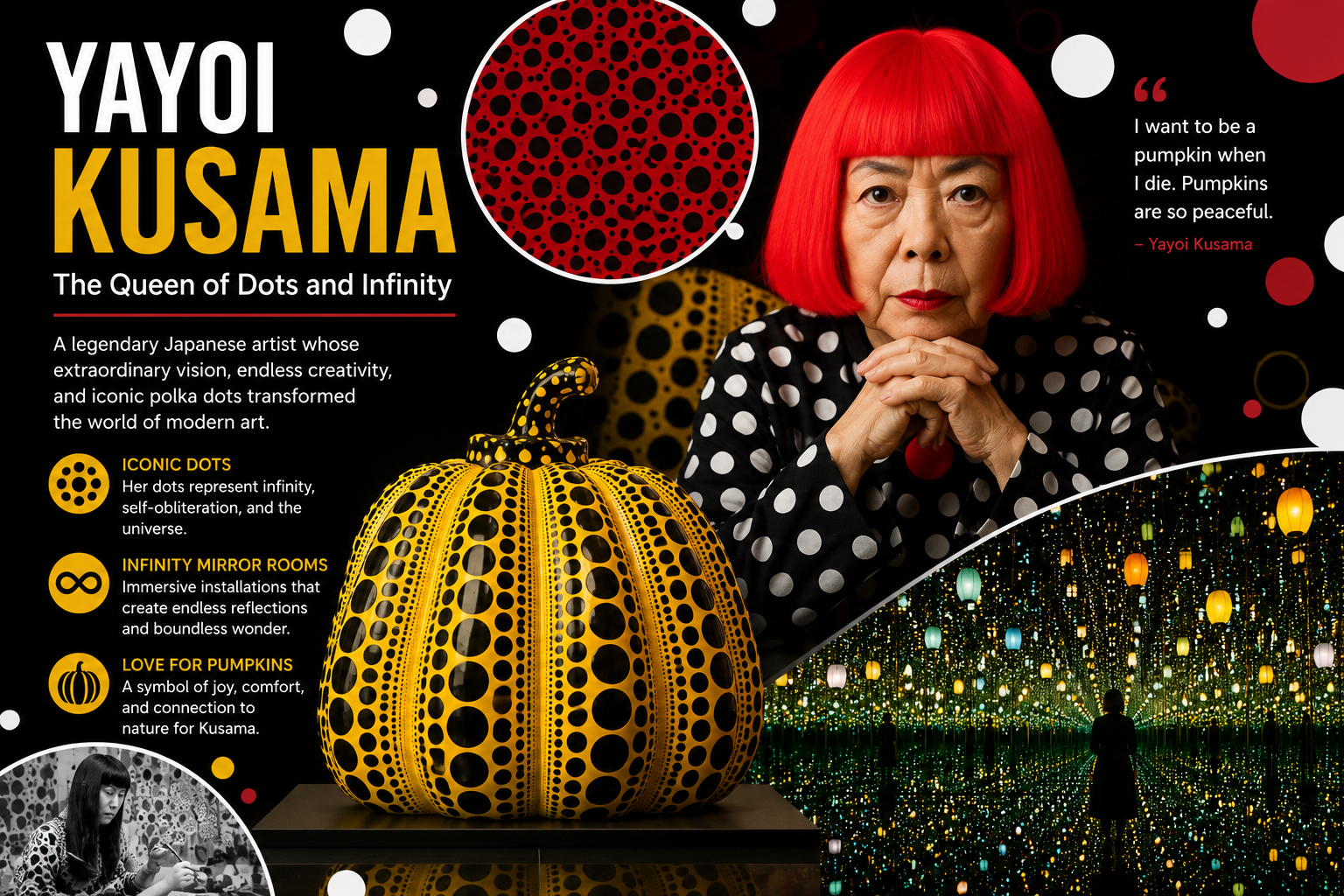
Yayoi Kusama became one of the most recognizable figures in modern and contemporary art through a visual language that is almost impossible to mistake. Polka dots, mirrored spaces, pumpkins, repeating patterns, bright colors, and ideas about infinity appear throughout her long career.
But reducing Kusama to her famous dots misses much of what makes her work significant. She worked across painting, sculpture, installation, performance, film, fashion, fiction, and poetry. Her career also crossed several major movements in postwar art, including Pop Art, Minimalism, and experimental performance.
Kusama was born in Matsumoto, Japan, in 1929. She moved to the United States in the late 1950s, became involved in New York’s avant-garde scene, and later returned to Japan. Her work eventually reached museums and audiences around the world.
A current note: Kusama died in Tokyo on August 14, 2026, at the age of 97, according to announcements from the Yayoi Kusama Museum and major art institutions.
Who Was Yayoi Kusama?
Yayoi Kusama was a Japanese avant-garde artist and novelist whose career lasted for more than seven decades. She developed a highly personal style based on repetition, multiplication, mirrors, dots, nets, organic forms, and the concept she called self-obliteration.
She was born in Matsumoto City in Nagano Prefecture. According to her official biography, Kusama experienced visions and hallucinations from childhood, and these experiences influenced her early drawings and the development of her recurring visual motifs.
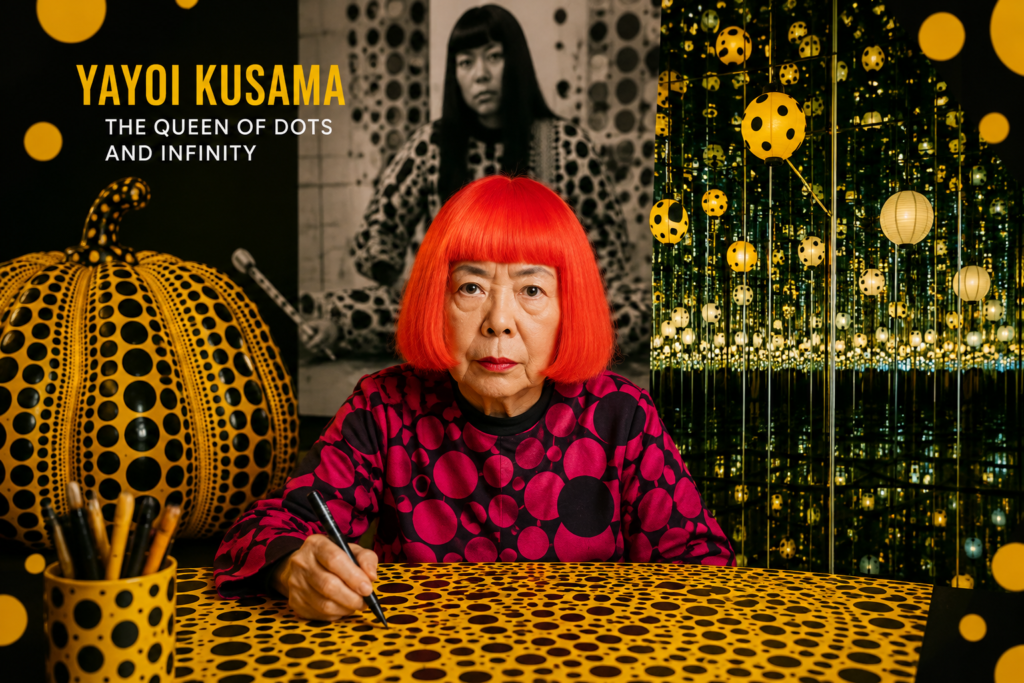
Rather than treating repetition as a simple decorative technique, Kusama turned it into a way of exploring identity, space, infinity, nature, and existence.
Yayoi Kusama’s Early Life and Education
Kusama began creating art at a young age. She later studied traditional Japanese-style painting, known as Nihonga, in Kyoto. However, she wanted to explore a less conventional artistic language.
Her family did not fully support her ambitions to become a professional artist. Tate notes that her mother encouraged a more traditional path rather than an artistic career.
Kusama continued working despite these obstacles. By the early 1950s, she was exhibiting her art in Japan.
Her early paintings already showed an interest in repetition and abstraction—ideas that would become central to her mature work.
Why Did Yayoi Kusama Move to New York?
Kusama moved to the United States in 1957 and settled in New York. The move proved crucial to her development as an artist.
In New York, she produced large paintings covered with repeated marks and patterns. These became known as her Infinity Net paintings.
She also experimented with soft sculptures, installations, mirrors, lights, performances, and happenings.
Kusama became part of an energetic avant-garde environment during the formative years of Pop Art and Minimalism. Museums such as the Hirshhorn note that she exhibited alongside influential artists including Andy Warhol, Claes Oldenburg, and Allan Kaprow.
Her work was distinctive, but her influence was not always fully recognized during her early years in America.
What Are Yayoi Kusama’s Infinity Nets?
The Infinity Nets are among Kusama’s most important early bodies of work.
They consist of repeated, closely connected marks that can cover an entire canvas. Instead of presenting a traditional central subject, Kusama creates an almost endless surface.
The effect can feel peaceful from a distance but intense when viewed closely.
The paintings also help explain why repetition became so important to her. A single mark is repeated until the individual gesture seems to disappear into a larger field.
That process connects directly to Kusama’s idea of self-obliteration—the disappearance of the individual into an infinite environment.
Why Are Yayoi Kusama’s Polka Dots So Famous?
Polka dots are perhaps Kusama’s most recognizable visual symbol.
For Kusama, dots are more than a fashionable pattern. They can represent repetition, infinity, the relationship between the individual and the universe, and the disappearance of boundaries.
Her official biography explains that her early visions contributed to her development of polka-dot and net-themed drawings.
Kusama later expanded the dot motif beyond paintings. Dots appeared on sculptures, rooms, objects, clothing, performances, and large public installations.
The result is a visual world in which a simple shape can completely transform a space.
What Are Yayoi Kusama’s Infinity Mirror Rooms?
The Infinity Mirror Rooms are immersive installations designed to surround visitors with reflections, lights, repeated forms, and the sensation of seemingly endless space.
Instead of simply looking at an artwork from outside, visitors enter the artwork itself.
One important early example was Infinity Mirror Room—Phalli’s Field, first created in 1965. The installation used mirrors and repeated soft sculptures to create an environment that appeared to extend beyond its physical boundaries.
Later works developed this concept with electric lights, mirrored surfaces, water, pumpkins, and other visual elements.
These rooms became a major reason Kusama’s work reached such a broad international audience. They transform abstract ideas about infinity into something visitors can physically experience.
Yayoi Kusama and Her Famous Pumpkins
Pumpkins are another major part of Kusama’s artistic identity.
Her pumpkin sculptures often feature bright colors and repeating black dots. At first glance, they can look playful and cheerful. Yet they also fit naturally into her broader interest in repetition and the transformation of ordinary forms.
The pumpkin has appeared in paintings, sculptures, installations, and mirrored environments.
The Hirshhorn, for example, has included Kusama’s Pumpkin (2016) among works representing her distinctive approach to sculpture and repetition.
Her pumpkins demonstrate how Kusama can take a familiar object and turn it into something visually strange, monumental, and memorable.
Yayoi Kusama’s Performance and Avant-Garde Work
Kusama was never only a painter.
During the 1960s, she organized provocative public happenings and performances in New York. These events explored themes including sexuality, politics, peace, the body, and social conventions.
Her performances often incorporated her signature dots and challenged conventional expectations about where art should happen.
This part of her career is especially important because it shows that Kusama’s work was not originally created simply for attractive photographs or museum installations.
She was actively questioning social rules and the boundaries between art, everyday life, and public space.
What Does “Self-Obliteration” Mean in Kusama’s Art?
Self-obliteration is one of the key ideas for understanding Kusama.
The term refers to the loss or disappearance of the individual through repetition and multiplication.
Imagine entering a room covered with mirrors and thousands of repeated lights. After a while, it becomes difficult to identify where the room ends or where your own reflection begins.
That experience captures something central to Kusama’s artistic philosophy.
The individual becomes part of a much larger visual field.
This idea also explains why her dots and mirrors work so well together. Both can weaken the visual distinction between one object and another.
Yayoi Kusama’s Return to Japan
Kusama returned to Japan in 1973 after spending years in the United States.
Her later career expanded beyond visual art. She wrote novels and poetry while continuing to create paintings, sculptures, outdoor works, and installations.
She also continued developing the Infinity Mirror Room series.
In 2017, the Yayoi Kusama Museum opened in Tokyo, providing a permanent institution dedicated to her work.
Her later recognition was enormous, but the foundation of that success was built through decades of experimentation.
Why Is Yayoi Kusama Important to Contemporary Art?
Kusama’s importance comes partly from her ability to move between different artistic forms without losing her distinctive identity.
She worked with:
- Painting
- Sculpture
- Installation
- Performance
- Film
- Fashion
- Photography
- Literature
- Poetry
- Public art
Museums have connected her work with Pop Art, Minimalism, psychedelia, performance, and other strands of contemporary art, while also emphasizing that her practice cannot be comfortably placed into a single category.
Her career also demonstrates how an artist can take a small number of simple visual ideas and explore them for decades without producing the same work repeatedly.
Yayoi Kusama’s Major Awards and Recognition
Kusama received many major honors during her lifetime.
Her official biography lists the Praemium Imperiale for painting in 2006 and Japan’s Order of Culture in 2016 among her honors.
She also represented Japan at the Venice Biennale in 1993, becoming the first woman to represent Japan at the event, according to the Smithsonian’s Hirshhorn Museum.
These achievements reflect the dramatic change in her reputation—from a highly experimental artist working on the margins to one of the most internationally recognized artists of her generation.
What Can We Learn From Yayoi Kusama’s Art?
Kusama’s career offers several useful lessons about creativity.
1. Repetition Can Become a Signature
A simple idea does not have to remain simple. Kusama repeatedly returned to dots, nets, mirrors, pumpkins, and infinity, but she kept finding new ways to combine them.
2. Personal Experiences Can Shape Art
Her childhood experiences and visions became important elements in her artistic language. Her work demonstrates how personal experiences can be transformed into visual concepts without being presented literally.
3. Experimentation Matters
Kusama moved between painting, sculpture, performance, installation, writing, and film. Her career shows the value of testing different forms rather than staying inside one category.
4. Popularity Does Not Erase Artistic History
Her work is now widely photographed and shared online, but her earlier career included challenging performances, experimental installations, and politically charged happenings. Understanding that history gives greater depth to her more popular works.
Common Misconceptions About Yayoi Kusama
One common misconception is that Kusama is simply the “polka dot artist.”
Dots are central to her work, but they are only one part of a much broader practice.
Another misconception is that the Infinity Mirror Rooms appeared suddenly as a recent trend. Kusama was experimenting with mirrors and immersive environments decades before social media made such installations globally popular.
It is also easy to view her colorful works as purely cheerful. Her art can be visually playful while dealing with much larger questions about identity, infinity, mortality, nature, and existence.
Frequently Asked Questions About Yayoi Kusama
Who was Yayoi Kusama?
Yayoi Kusama was a Japanese avant-garde artist and novelist known for polka dots, Infinity Nets, pumpkins, mirrored installations, paintings, performances, and her concept of self-obliteration.
Is Yayoi Kusama still alive?
No. Yayoi Kusama died in Tokyo on August 14, 2026, at the age of 97. Her death was announced by the Yayoi Kusama Museum on August 27, 2026.
What is Yayoi Kusama famous for?
She is best known for her polka-dot artworks, Infinity Mirror Rooms, Infinity Nets, pumpkin sculptures, immersive installations, and avant-garde performances.
What do Yayoi Kusama’s dots mean?
The dots can be understood in relation to repetition, infinity, self-obliteration, and the relationship between an individual and the larger universe. Kusama has described polka dots as a way of expressing infinity.
Where was Yayoi Kusama born?
Yayoi Kusama was born in Matsumoto City, Nagano Prefecture, Japan, in 1929.
What are the Infinity Mirror Rooms?
They are immersive installations using mirrors, lights, repeated forms, and reflections to create the sensation of an endless environment. They are among Kusama’s most famous works.
Did Yayoi Kusama only make paintings?
No. Her career included sculpture, installations, performance, film, fashion, photography, fiction, and poetry as well as painting.
Is there a Yayoi Kusama Museum?
Yes. The Yayoi Kusama Museum is located in Tokyo and opened in 2017. It continues to present exhibitions dedicated to her work and legacy.
Final Thoughts
Yayoi Kusama built an artistic language from repetition. Her dots, nets, mirrors, pumpkins, and endless reflections became much more than recognizable visual trademarks. They gave her a way to explore infinity, identity, nature, and the boundaries between the individual and the world.
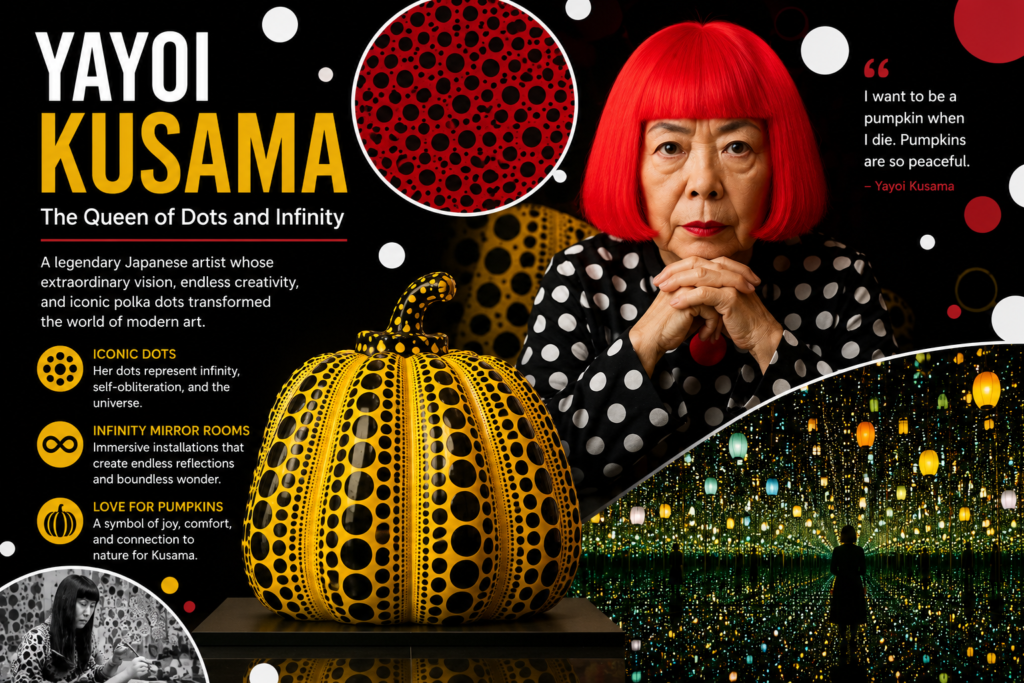
Her journey from Matsumoto to New York and eventually to worldwide museum recognition was long and unconventional. She continued experimenting across multiple forms of art and created a body of work that is immediately recognizable while still open to deeper interpretation.
Kusama’s death in 2026 marks the end of her life, but not the end of her influence. Her work remains in museums, collections, public spaces, books, and the memories of people who have experienced her immersive environments.
FAQ Section
Who was Yayoi Kusama?
A pioneering Japanese avant-garde artist and novelist known for dots, mirrors, pumpkins, Infinity Nets, and immersive installations.
When did Yayoi Kusama die?
She died on August 14, 2026, in Tokyo, aged 97.
What made Yayoi Kusama famous?
Her distinctive polka-dot artworks, Infinity Mirror Rooms, pumpkin sculptures, and experimental career made her internationally famous.
What is self-obliteration?
It is Kusama’s artistic concept of losing the sense of individual identity through repetition and multiplication.
Where was Kusama born?
She was born in Matsumoto City, Japan, in 1929.
What are Kusama’s Infinity Mirror Rooms?
Immersive mirrored installations that use reflections, lights, and repeated forms to create an apparent sense of infinite space.
Did Kusama work in other art forms?
Yes. She worked in painting, sculpture, installation, performance, film, fashion, fiction, and poetry.
Is the Yayoi Kusama Museum still open?
The museum in Tokyo continues its exhibition program and preserves Kusama’s artistic legacy.